




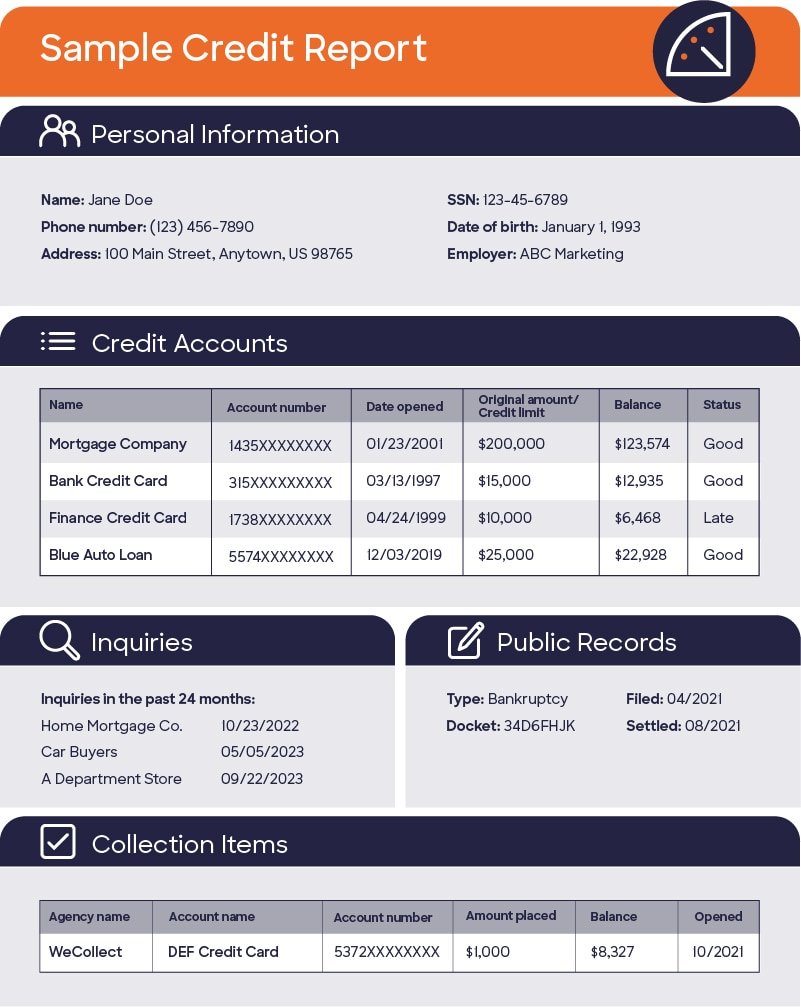
Your credit report is a snapshot of your credit history, and it includes your personal information, credit accounts, inquiries, public records, and collection items. The information contained in your credit report is used to determine your credit score. In this article, we’ll cover how to read a credit report and what each section means.
Lenders use the information from your credit report to help them decide whether to give you a loan. If they decide to lend you money, these details can factor into determining your loan amount and interest rate.
Because of this, it’s a good idea to check the information in your credit report each year. Doing so lets you keep an eye out for possible errors and spot potential identity theft. A full understanding of your credit report may help you both protect and improve your financial health.
What is the definition of a credit report?
A credit report is a record of your borrowing activity. It shows things like the status of your accounts and your history of making payments on your loans.
The information on your credit report is collected from various lenders, including credit card companies and other financial companies. Creditors are not required to report your activity to each credit reporting agency, so it’s a good idea to check all three reports.
Looking at your credit report for the first time may be confusing. But it doesn’t need to be. We’ve broken it down to help you make sense of it all.
How do you get your credit report?
There are three credit reporting agencies, also called credit bureaus or consumer reporting agencies: TransUnion®, Equifax®, and Experian®. You can request a free copy of all three of your credit reports annually from annualcreditreport.com. You may also check your credit report online from each credit bureau once a week for free. Checking your own credit reports will not impact your credit score.
What is included in a credit report?
Although each of the three credit reporting agencies may present your information differently, your credit report will include five important areas:
Each category contains information that you should review. Look for things you do not understand or that you believe to be inaccurate. Contact the credit reporting agency if you have any questions or disputes. This can be done free of charge and without affecting your credit score.
Personal information
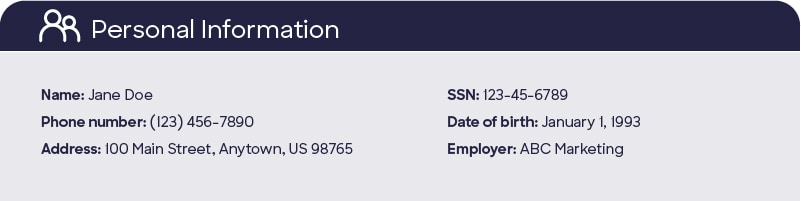
The first section in your credit report shows your personal information. While the information listed does not affect your credit score, you should check that all the details are accurate and complete. Incorrect information may be a sign that you are a victim of identity theft or that an error has occurred.1
If you do see errors, contact the credit bureau to update the information. Lenders use these details to match your credit
Here is the personal information that this section may include:
- Your name and any name you might have used in the past in connection with a credit account
- Social Security number or taxpayer identification number
- Current and former addresses
- Date of birth
- Phone numbers
- Employment history, although a missing employer is not a cause for concern
What to check
- Unfamiliar addresses—if you see an address you don’t recognize this could be identity theft
Credit accounts
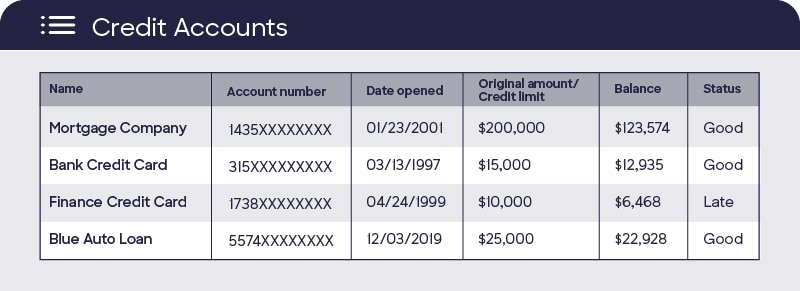
Your credit account information lists the companies that have issued you credit. It will include your current loans and loans or accounts you’ve had in the past. Some lenders don’t report information to all three credit reporting agencies. That’s one reason why it's important to review your credit report from each of the three.
You will want to ensure that you recognize each account, and that the information is correct. Negative information, such as late payments on a loan or credit card account, could be the result of a mistake or the result of fraud. This type of information can remain on your report for up to seven years. Past accounts in good standing should remain on your report for 10 years.
This is some of the information that the credit accounts section typically includes:
- Current and historical credit accounts
- Name of creditor
- Credit limit or amount
- Account balance
- Dates account was opened and closed
- Account payment history
What to check
- Unfamiliar accounts should be disputed immediately
Your payment history may also record when payments are late. Creditors will typically report late payments in 30-day increments:
- 30 days late
- 60 days late
- 90 days late
- 120 days late
- 150 days late
If the amount due is considered uncollectible by the lender, that is also recorded on your credit report. The past-due amount may be sent to a collection agency.
Each of these late categories may have a negative effect on your credit score. The later a payment is, the more it may hurt your credit score. Because of this, it is important to stay current on your payments or to make payments that keep your account from falling into the next 30-day late category.
Inquiries
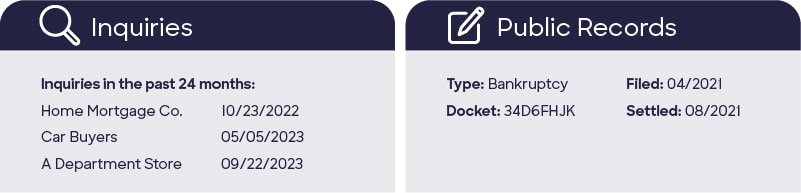
Credit inquiries, also known as credit checks, happen when a company or person has a legal reason to look at your credit report. Only so-called “hard” inquiries are shown to potential lenders, though you might see “soft” inquiries when you check your own credit report. Having too many hard inquiries in a short time can raise a red flag to potential lenders. This may suggest that you are trying to take out too many loans.
- Hard: A hard inquiry is made when you apply for credit, including a mortgage, credit card, personal loan, or car loan.
- Soft: A soft inquiry may occur for several reasons, including if you are researching possible loans, if employers are conducting a background check, or if lenders are deciding whether to send you a pre-approved offer.
Public records
This area of your credit report refers to public records that might affect your creditworthiness. Up until recently this may have included bankruptcy filings, tax liens, and civil judgments. However, bankruptcies are now the only public record that reporting agencies list. Other records continue to be publicly available elsewhere.2
Since a bankruptcy filing can make it harder and more expensive to get new loans, it is important to check these items and ensure that they are accurate. Remember that any bankruptcy filing should be removed from your report after seven to 10 years.
What to check
- Bankruptcy information you don’t recognize
- Incorrect filing or discharge dates
- A bankruptcy that should no longer appear on the report
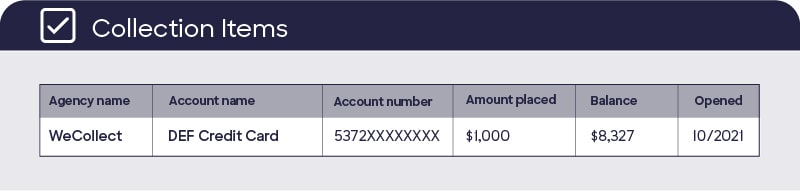
Collection items
A collection item is an account that became past due and was moved to a collections department or sold by the lender to a separate collection agency or debt collector. When that occurs, the account is listed in this section of your credit report.3 As with other information in your report, you would want to ensure that these items are valid.
Keep in mind that a late payment or an account that has moved into collections may have a negative impact on your credit score. It might make obtaining a loan more difficult or more expensive. These items can remain on your credit history for seven years after you first miss a payment.
The section about collection items typically includes this information:
- Account information
- Date the collection account was opened
- Name of original creditor
- Original loan amount and current amount owed
- Your statement of explanation or dispute
What to check
- Late payments reported in error
- Items still listed after 7 years
- Collections you don’t recognize
What is not included in your credit report
While much of your credit history is contained in your credit report, there are significant areas of your personal and financial life that are not. These include your income; your investments; your bank account balances; any medical information; criminal records; level of education; marital status; and your race, religion, ethnicity, political affiliations, or disabilities.
Who can see your credit report?
No one can check your credit report without a legitimate need to assess your financial situation. Often written permission is needed before they can review your report—this can come in the form of signing an application for loan or credit card or signing a specific request form from an employer or landlord.
Organizations or lenders that can see your credit report include:
- Banks
- Credit card companies
- Mortgage lenders
- Other lenders
- Landlords
- Utility providers
- Insurance companies
- Employers
- Certain government entities
What are your rights regarding your credit report?
Your credit report might also include an overview of your rights as found in the federal Fair Credit Reporting Act and elsewhere. This would typically be included at the end of the report. Knowing your rights helps ensure that you know what protections you have as a consumer.
While it is important to review your credit report for correct information, know that some details only stay on your report for a set number of years, as determined by laws and regulations.
Hard inquiries remain on your credit report for two years, but only those from the past 12 months will affect your credit score. Closed accounts that had a history of on-time payments could remain up to 10 years, while accounts with negative information may only stay up to seven years.4 It is important to verify that all information is up to date and adheres to current consumer protection laws.
You also have the right to add certain statements to your credit report. These might include identity theft, service-member alerts, or a notice to freeze any credit activity.
Are credit reports the same as credit scores?
No, credit reports and credit scores are not the same. Your credit report is a detailed look at your credit history. Your credit score is all of that data calculated into one score which represents your credit health.
Your access to many financial products depends on your credit score—that’s why it’s important to understand what your credit report contains, what it means, and when to dispute incorrect information.
Why do your credit reports matter?
It is recommended that you review your credit reports at least once a year as an important step to protect your financial health. The Consumer Financial Protection Bureau even provides a checklist to help you review your credit reports. With a detailed list of your credit accounts and balances, you can better manage your borrowings, create an effective budget, and save money on interest.
How can you use your credit report to improve your credit health?
In addition to being an important tool for lenders, your credit report can also give you valuable insights into your own financial health.
When you review your credit report, for example, you might come across accounts you forgot about or late payments you were unaware of. You can also see recent balances on your existing accounts. This may help you assess whether there are steps you could take to simplify your finances and save money.
One key step might be to consolidate several accounts into a personal loan. Personal loans may be used to consolidate credit card debt. Combining multiple higher-rate balances into a single loan with one set, regular monthly payment might save you on interest. Understanding your credit report and ensuring it’s accurate can make your loan application stronger.
Tags:
Articles may contain information from third parties. The inclusion of such information does not imply an affiliation with the bank or bank sponsorship, endorsement, or verification regarding the third party or information.
The information provided herein is for informational purposes only and is not intended to be construed as professional advice. Nothing contained in this article shall give rise to, or be construed to give rise to, any obligation or liability whatsoever on the part of Discover, a division of Capital One, N.A., Discover or its affiliates.
1 https://www.transunion.com/how-to-read-your-credit-report
2 https://www.premiercommunity.com/what-public-records-appear-on-your-credit-report.html
3 https://www.transunion.com/blog/credit-advice/how-long-do-collections-stay-on-your-credit-report
4 https://www.congress.gov/crs-product/IF12169