




The economy cycles through periods of expansion, slowdowns, recessions, and rebounds. But things change, and watching signs like unemployment rates and business activity can help you understand the direction of the economy. For example, some things that usually happen before a recession—inflation and high interest rates - are worth keeping an eye on.
Recession or not, it’s never a bad idea to keep your finances in order so you can deal with whatever comes your way, as well as benefit from a better economy in the future. We’ll help you get started with some basic information about how economic cycles work, what defines a recession, and how your finances might be impacted.
Table of Contents
- What is the economic cycle?
- What is a recession?
- What causes a recession?
- How does a recession affect me?
- What happens after a recession?
- What should I do after a recession?
What is the economic cycle?
The economic cycle, also known as the business cycle, describes the regular ups and downs of the economy.
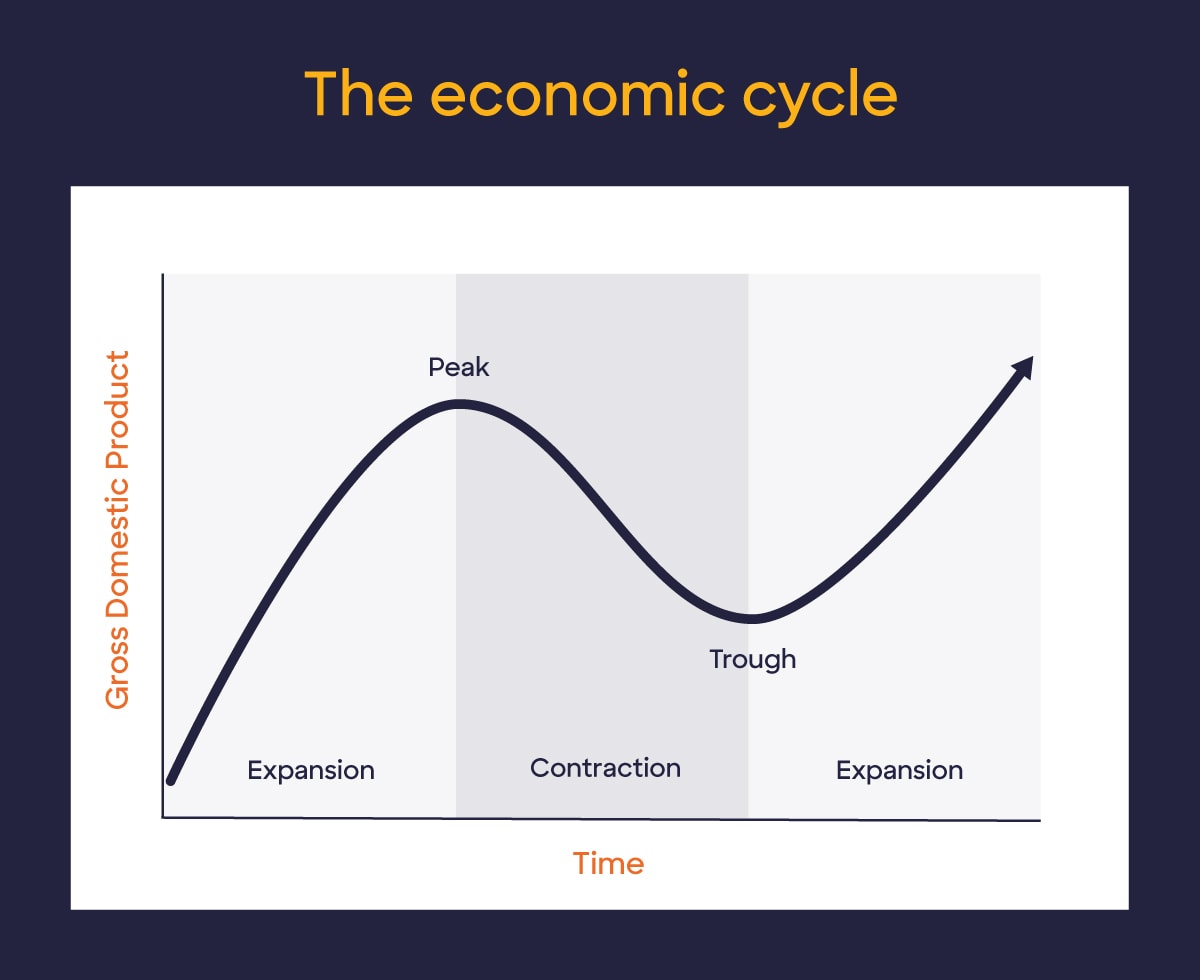
The economic cycle has four phases. Understanding them could help you make informed decisions about your money before a recession. And it may help you get ready for what comes after a recession.
The four phases of the economic cycle are:1
- Expansion: This is the period of economic growth that follows the bottom of the cycle as a recession ends.
- Peak: When the expansion reaches its highest point.
- Contraction: In this phase, economic activity shrinks, and a recession could start.
- Trough: The contraction bottoms out and economic activity picks up again.
What is a recession?
A common way to define a recession is when the gross domestic product (GDP) falls for two quarters in a row. (GDP is the total economic output of the country.) But that is not an official definition.2
A committee of economists at the National Bureau of Economic Research decides when a recession starts and stops.3 According to this group, a recession is “a significant decline in economic activity that is spread across the economy and lasts more than a few months.”
The good news is that the economy is usually in expansion mode.1 But recessions do happen. Significant events like a banking crisis or a stock market plunge can set them off.
What Causes a recession
A recession can be caused by any combination of different factors. Here's a few common causes:
- A drop in consumer and business spending
- Financial crises
- High interest rates
- Inflation
- Supply shocks (oil prices spikes, supply chain disruptions)
- External shocks (pandemics, wars, global crises)
There are different kinds of recessions
While recessions have many similarities, they are by no means all the same. Some recessions are deep and short. Economists call these “V-shaped recessions.”
Others are less severe, but last longer and are called “U-shaped” recessions.
Some recessions are shaped like a “W,” also known as a double-dip recession. That’s when economic activity falls, then rebounds, falls again, and rebounds for good.
How does a recession affect me?
They say that when your neighbor loses their job, it’s a recession. But when you lose your job, it’s a depression. People feel recessions differently depending on what happens to them.
What happens in a recession can impact the average person in a number of ways. The biggest is through layoffs and difficult job markets. A recession might make it hard to land a new job, and wages are likely to be lower during or after a recession than before. It could be hard for recent college graduates to find their first jobs. During the 2007-09 recession, for example, the unemployment rate reached 9.5% in June 2009,4 over two times the June 2026 of 4.2%.5
The stock market also usually falls during a recession. That can cause your retirement savings and other investments to fall in value.
Lastly, it’s harder to borrow money during a recession. Lenders may want to lend to only the most creditworthy borrowers because they worry about getting paid back.
Even if your job is secure and you don’t have an investment portfolio, you might still feel uneasy during a recession. It’s unsettling to see those close to you struggling.
What happens after a recession?
As a recession begins to lift, you might start to see improvements. In the beginning, these economic “green shoots” might be small and hard to notice. It could take time to see more concrete signs in your own life.
These are some common signs that the economy is growing. Being aware of them may help you take advantage of improving economic conditions.
Lower prices
Costs may lower after a period of high inflation.
Lower interest rates
The Federal Reserve may lower interest rates during a recession in hopes of increasing business activity.
More lending
When economic growth is strong, banks see increased loan demand and improved lending returns.
New business opportunities
A recession can be a good opportunity to launch a new business.
Some iconic American businesses such as Revlon (1932),6 Hyatt (1957),7 and Microsoft (1975),8 started during past recessions.9
What should I do after a recession?
Because periods of growth tend to last longer than recessions, they may give you time to rebuild your finances if they took a hit during the last downturn.
Low unemployment rates and higher salaries may help you save more money for your future.
And if interest rates fall, it could be an excellent time to consolidate higher-interest debt into a lower, fixed-rate loan—which may free up money in your day-to-day budget.
Taking steps to lower your monthly expenses during good economic times, may be a good strategy to keep your finances in order in advance of a downturn.
The bottom line
Knowing all the phases of the economic cycle could help you understand where the economy stands and what actions you should take.
Recessions can be unpleasant and even a little scary. But remember: They are temporary. You could use periods after a recession ends to improve your financial position by building your savings and reducing debt.
That way, you could be better prepared for whatever phase of the economic cycle comes next.
Want to read more about how to prepare your finances?
Tags:
Articles may contain information from third parties. The inclusion of such information does not imply an affiliation with the bank or bank sponsorship, endorsement, or verification regarding the third party or information.
The information provided herein is for informational purposes only and is not intended to be construed as professional advice. Nothing contained in this article shall give rise to, or be construed to give rise to, any obligation or liability whatsoever on the part of Discover, a division of Capital One, N.A., or its affiliates.
1 https://www.investopedia.com/terms/b/businesscycle.asp
2 https://www.imf.org/external/pubs/ft/fandd/basics/recess.htm
3 https://www.nber.org/research/business-cycle-dating#:~:text=The%20NBER's%20Business%20Cycle%20Dating,subsequent%20trough%2C%20or%20lowest%20point.
4 https://www.bls.gov/spotlight/2012/recession/pdf/recession_bls_spotlight.pdf
5 https://www.bls.gov/news.release/pdf/empsit.pdf
6 https://www.revloncorp.com/pages/our-history
7 https://about.hyatt.com/en/hyatthistory.html#:~:text=Hyatt%20was%20founded%20by%20Jay,the%20Los%20Angeles%20International%20Airport
8 https://news.microsoft.com/facts-about-microsoft/
9 https://www.sofi.com/learn/content/us-recession-history/